

Does German Prime Minister Wear Makeup

By Karl Vick / Berlin with Simon Shuster
Photograph by Steffen Kugler
Fairy tales are where y'all find them, simply any number seem to brainstorm in the night German woods where Angela Merkel spent her childhood.
The girl who would grow up to be chosen the most powerful woman in the world came of age in a glade dappled by the northern sun and shadowed past alpine pines.
Her family's house stood three stories, and the steep rake of its tile roof held an attic window in the shape of a half-open centre. Strangers walked on the paths below, passing residents who often moved at curious gaits. Cries of ache were sometimes heard. To adults, Waldhof was home to the Lutheran seminary run by Merkel's father, an isolated chemical compound—"forest court" in English—that hosted students and other brusk-term visitors while also functioning as a domicile and workplace for mentally disabled adults. But to a kid of 3, Angela'south age when her family arrived, it was a earth unto itself, and would remain so until she went to schoolhouse in the bordering town of Templin. There, she came to realize that, similar the 17 million other residents of E Germany, she actually was living within the walls of a fortress.
Merkel remained a convict for the first 35 years of her life, biding her fourth dimension. As an adult, she lived in East Berlin, riding an elevated train beside the barricade whose 1961 structure she recalled every bit the offset political memory of her life. When it fell in 1989, she gathered the qualities cultivated as a necessity in the East—patience, blandness, intellectual rigor and an camouflaged but ferocious drive—and changed not merely her life merely the course of history.
The year 2015 marked the start of Merkel'due south 10th year every bit Chancellor of a united Frg and the de facto leader of the European Spousal relationship, the most prosperous joint venture on the planet. By year's finish, she had steered the enterprise through non one merely two existential crises, either of which could accept meant the finish of the union that has kept peace on the continent for 7 decades. The first was thrust upon her—the slow-rolling crisis over the euro, the currency shared by nineteen nations, all of which were endangered by the default of a single member, Hellenic republic. Its resolution came at the signature plodding pace that so tries the patience of Germans that they have fabricated it a verb: Merkeling.
The 2nd was a thunderclap. In late summer, Merkel'south government threw open Germany's doors to a pressing throng of refugees and migrants; a total of 1 million asylum seekers are expected in the country by the end of Dec. It was an audacious human action that, in a single motility, threatened both to redeem Europe and endanger it, testing the resilience of an brotherhood formed to avoid repeating the kind of violence tearing asunder the Middle East past working together. That arrangement had worked well enough that it raised an existential question of its own, now being asked by the richest state in Europe: What does it hateful to live well?
Merkel had her reply: "In many regions war and terror prevail. States disintegrate. For many years nosotros take read virtually this. We have heard about it. Nosotros accept seen it on TV. But nosotros had not nonetheless sufficiently understood that what happens in Aleppo and Mosul can affect Essen or Stuttgart. Nosotros accept to face that now." For her, the refugee decision was a galvanizing moment in a career that was until and then divers past caution and avoidance of anything resembling drama. Analysts called it a jarring difference from grade. But it may also take been inevitable, given how Angela Merkel feels about walls.
What was non inevitable but merely phenomenal was that the most generous, openhearted gesture of recent history blossomed from Deutschland, the land that within living memory (and beyond, equally long as there'southward a History Channel) blew autonomously the European continent, and then the earth, past taking to gruesome extremes all the forces its Chancellor strives to hold in bank check: nationalism, nativism, self-righteousness, reversion to arms. No 1 in Europe has held office longer—or to greater upshot—in a world defined by steadily receding barriers. That, after all, is the story of the E.U. and the story of globalization, both terms as colorless equally the corridor of a Brussels office edifice. The worlds Merkel has mastered conduct not a hint of the forces that have shaped Europe'south history, the primal sort a child senses, listening to a story, safe in bed.

In some means, living in East Germany was like living on a stage prepare. The German Democratic Republic called itself a sovereign nation, but it was Moscow's closest satellite in the Soviet bloc. Its deeply paranoid government put great shop on appearances, employing thousands to spy on other citizens. Information technology minted coins that felt strangely lite in the palm—they were fabricated of aluminum—and many streets were facades. "I stayed there for six or nine months in 1981. My impression is it was 1947 or '48," says Peer Steinbrück, a Social Democrat who both lost to Merkel and served every bit her Finance Minister. "Backside Unter den Linden, all these buildings were yet destroyed. Bullet scars on the walls."
Erika Benn had the same feeling when she arrived in Templin in 1965 from university at Leipzig to teach Russian: "I said, Where have I ended up? My God." The medieval town had a history, with a church that dates to the 14th century. Merely churches were merely tolerated in the Gdr, which was officially atheist.
That made public life frail at Waldhof. Merkel's father, Horst Kasner, had moved his family at that place in 1957, after leaving Hamburg, where Angela, the first of three children, was born. Most people were moving in the other direction, to the West. But the Lutheran Church enjoyed a standing in German language society that brought a measure of deference even from Marxist-Leninists. Its parishes in the East became refuges for dissidents, something like embassies. That in turn brought anyone associated with them additional scrutiny, though Kasner'due south situation was tempered past his enthusiasm for socialism—at least every bit he understood it—and an evident talent for navigating the state apparatus.
It also helped that the pastor embraced a school of theology that steered clear of social activism and instead sought to reconcile the work of mod philosophers like Immanuel Kant with religious belief, co-ordinate to a former adviser to Merkel. The discussions young Angela grew up amid in the parsonage were erudite and rigorous. Her female parent Herlind, trained as an English language teacher, was never allowed to teach the linguistic communication. At schoolhouse, Angela enrolled in Russian with Frau Benn.
The retired teacher keeps a file folder on her star student. Pulling out a blackness-and-white group photo, she points out Merkel in the back row, recognizable mostly by her helmet hair. "That's how she was: the daughter in the back," says Benn. "She's near almost invisible. It's so typical of her, I can't even tell you."
Equally an adolescent, Merkel both lived inside her head and exulted in the outdoors. Physically clumsy, she avoided sports but camped with friends, all while excelling at school. Every bit she got older, she explored as much of the world as a denizen of the Soviet bloc was permitted. The system's limits on wanderlust rendered Merkel, waiflike in her youth, with her confront pressed up confronting the glass of a warm store window.
She journeyed to Bulgaria and stared over the border toward the forbidden hillsides of Hellenic republic. She watched, every bit almost anybody in the GDR did, telly stations beamed from Due west Germany, and dreamed of visiting California. Merkel understood that she would not be permitted to go there until she was sixty, the age at which E Germany trusted its citizens to travel to the Westward. All the same she began to program for it. Patience was a lesson of life in the East, as was realism.
"You know I grew up in the Gdr," Merkel told a security conference in Munich in February, where she was peppered with demands that Russian President Vladimir Putin's incursion into Ukraine be answered with armed services force rather than the economical pressure level Merkel had spearheaded. "As a seven-year-one-time child, I saw the Wall being erected. No one—although information technology was a stark violation of international law—believed at the time that 1 ought to intervene militarily in order to protect citizens of the Gdr and whole Eastern bloc of the consequences of that, namely to live in lack of freedom for many, many years. And I don't actually mind. Because I understand this, because it was a realistic cess that this would not lead to success."
Merkel plays the long game, in other words. For a career, she shrewdly chose a path in the field that communists worshipped instead of God: science. She studied physics at Leipzig University and married another scientist, Ulrich Merkel. She ended the marriage after 5 years only kept his name, even afterward marrying her current husband, Joachim Sauer, a quantum chemist, after years spent living together.
More that, she retained the disciplines of scientific enquiry learned on the way to a Ph.D. in quantum chemistry—intellectual diligence and a quest for the virtually reliable data. In combination with her natural, seemingly endless curiosity, the consequence was an inquisitiveness rare for a politician. Merkel also retained the survival instincts honed in a country where any citizen might testify to be a Stasi informant—the GDR'southward security agency had 274,000 agents—and the discretion intended to mask behavior that emerged only when it was safety. But they did emerge.
"We've e'er had this experience that things take long, simply I'm 100% convinced that our principles volition in the end prevail," she told the audition in Munich. "No ane knew how the Cold War would end at the time, but information technology did end. This is within our living experience … I'yard surprised at how fainthearted we sometimes are, and how quickly we lose backbone."
The day the Berlin Wall came down, Nov. 9, 1989, Merkel was nigh to have her regular Thursday-nighttime sauna with a friend. A creature of habit, she kept to her routine, finishing her sweat before venturing with the crowds into West Berlin. She stopped in an apartment, talked to the people there and had a beer. The label on information technology was unfamiliar. Then she went back across no-man's-land and changed her life. She was 35 years sometime.
No obvious natural purlieus separates Austria from Frg. The snowy mountains of Bavaria wait an awful lot like the snowy mountains of Austria, and the two-lane highway from Kiefersfelden, in one country, to Kufstein, in the other, is a smoother transition than from Maryland to Pennsylvania—not fifty-fifty the road surface changes. You most have to ask a local to know what country you're in.
This dubiety counts as one of the not bad triumphs of the mod age. In the past lxx years, supreme efforts have been fabricated to erase national boundaries in Europe or at least render them harmless. This try is known as the Eu, which includes 28 countries and, it must be said, is reliably boring. But that's the whole idea. For thousands of years, the Continent generated not white papers just wars too numerous to mention—especially to Americans, who know them only from textbooks and strain to recall them only until the written test. "Europe'southward Wars, 1648–1789: A Selection" takes up two pages in Appendix 3 of Norman Davies' Europe: A History.
But anybody knows World War Two, the cataclysm that yet defines Federal republic of germany for many, not least because the Nazis are a staple of global popular civilization as a stand-in for unqualified evil. That war claimed at least 50 million lives worldwide, well-nigh of them civilians, and produced a raft of international institutions—from the United nations to the International Monetary Fund—aimed at preventing anything like it from happening again. The i that ultimately mattered most was idea upward by the countries with the bloodiest records: the postwar leaders of France and Frg began the European Coal and Steel Community, which grew even blander as it expanded. Past the time information technology was called the Eu, in 1991, the supranational organization had been done of all color. Countries surrendered elements of sovereignty to it in substitution for access to shared markets and an overarching identity as European, their citizens able to move among 26 countries without showing a passport and among 19 without having to change money. Founded on a serial of interlocking treaties, the E.U. exists, a cynic could say, largely as an endless series of meetings and most countless regulations.
On the other manus, none of its members has raised more than a voice against another for seven decades—a modern record. In 2012, the E.U. was awarded the Nobel Peace Prize. The gold medal was accepted by 3 officials, none of whom actually ran the union. Past so, that responsibility had fallen, more or less, to Merkel.
To a big extent, the job came with the territory. Merkel was Chancellor of Germany, and Frg was the most populous and prosperous fellow member in a wedlock that had become a lucrative club. Equally globalization rewarded scale and standardization, E.U. membership became a ticket to prosperity, especially for members of the onetime East bloc. German manufacturers, working in concert with labor outsourced to its poorer neighbors, congenital an consign economy that remains the healthiest in Europe and the fourth largest in the world.
But Merkel was made for the task. The E.U.'s mission of removing barriers and spreading commonwealth was her mission likewise. And the plodding, patient manner she brought from the laboratory meshed with the E.U. mandate encouraging decision past consensus. She appeared to exist the perfect person to navigate the euro crisis, which began in 2010 and reached equilibrium this year. By then, she was being caricatured with Hitler's mustache, and Germans had coined the discussion Merkeling.
The problem was Greece. The land that gave the world democracy was supplying it with headaches. Athens was broke and carried debts information technology could never hope to pay. If the land still had its own currency, it might at least dilute the problem by printing more of it. But similar 18 other E.U. countries, Greece had exchanged its money, the drachma, for the euro—and the only manner to pay its debts was by request its neighbors for more euros. Merkel stood by the cash register, with her lessons from E Frg. In that location the collapse of the Wall had been swiftly followed by the collapse of the economy, an event as traumatic every bit the breach had been euphoric, merely experienced merely by the Ossies, every bit Eastward Germans were chosen. What's more, the trigger had been a common currency: the abrupt introduction of the W German deutsche marker to the East shuttered factories, putting millions out of work, including Merkel.
"I come from a country in which I experienced economic collapse," Merkel reminded reporters in 2012. If Greece's debt was not reduced "sustainably and with a view to the long term, Europe simply will no longer exist the prosperous continent that the world listens to and that gets people'due south attention."
What got people'due south attention during the saga of Greece—and Portugal, and Ireland, and briefly Italy, but first and last, Hellenic republic—was Merkel's stern mien. She wasn't the only Northerner preaching austerity to the sunny Mediterranean nations that spent money they did not take. But it was Merkel who became the face of the European banker, caricatured here as a dominatrix, there equally a storm trooper. The crisis went on for years, and Merkel's image grew as entrenched as her position: rescue only if Greece ended its spendthrift ways.
It wasn't entirely Athens' mistake; the euro had a deeper problem that dated from its nativity: the currency bound nations together economically without a parallel political appliance, a trouble Merkel diagnosed and prepare out to eventually solve through lengthy treaty renegotiations. But the immediate political problem was the civic culture of Greece, where the rich avoided taxes and governments spent lavishly. Greeks rioted, a government roughshod. But in the end, the leaders who hoped to defy Merkel'south E.U. had no choice simply to back downward. It was either face expulsion from the euro zone or swallow thrift measures that gutted pensions and public services. The saga cemented Merkel'due south condition as leader of Europe, if a dank i.
"They call me 'Little Angela Merkel' when they think I'g beingness too strict," says Angela Klingbeil, of her colleagues at the Berlin business firm where she heads accounting. Klingbeil smiles grimly, looking into the remains of the cappuccino she was sipping at an outdoor café in Alexanderplatz, the former center of East Berlin. Today its retail temples outshine the Kurfürstendamm, the marquee shopping street deliberately fashioned to annunciate the attractions of capitalism to East Germans similar Merkel. The Chancellor has recalled darting from shopping basket to shopping basket "like a lynx" to run into who had emerged from a store with a line worth joining. Toothbrushes and underwear were item treasures.
Merely life in a consumer paradise begs a mod question: How much shopping tin yous do? In December 2014, Pope Francis traveled to Strasbourg to chide the European Parliament—one of the vaguer institutions—about being and nothingness. The Argentine chosen Europe "less and less a protagonist" in a world that regards the continent equally "somewhat elderly and haggard." Said the Pontiff: "The great ideas which once inspired Europe seem to accept lost their attraction, only to be replaced by the bureaucratic technicalities of its institutions." He accused Europe'south leaders of confusing unity with uniformity and "the reality of democracy with a new political nominalism."
It was Merkel who nearly famously framed the euro crunch in existential terms—"If the euro fails, Europe fails," she said—but did that mean the spousal relationship was at bottom but virtually money? Merkel often says Ossies know that afterwards working hard in commutation for well-nigh naught, the ability to procure a decent living in exchange for difficult piece of work matters in the competition betwixt ideologies. But that'south not the same as existence coldhearted, the reputation stalking both Frg and its Chancellor when Merkel, with the euro crunch just winding down, appeared at a coming together with students on July 16. It was for a televised give-and-take called Living Well in Deutschland, and a young girl named Reem raised her paw and explained that her family unit members were Palestinian refugees and faced deportation to Lebanon.
"As long equally I don't know that I tin stay hither, I don't know what my future will be," the 14-year-sometime said in fluent German. "I want to study. Information technology'southward really painful to watch how other people tin enjoy life and y'all can't enjoy information technology with them."
The Chancellor looked taken aback. "I empathize," she began, "and yet I have to …" At that place was an easy way out: deflect the plea, perhaps promise to have someone expect at the family's file. Merkel went another way. "Sometimes politics is hard," she informed the daughter. "You lot're a very nice person, but you know that at that place are thousands and thousands of people in Palestinian refugee camps in Lebanese republic, and if we say, 'You can all come,' and, 'You can all come from Africa,' and 'You tin all come,' we just can't manage that."
Merkel bankrupt off a moment later because the girl was weeping. "Oh Gott," she muttered, moving across the room. "I want to condolement her." Merely the girl was inconsolable, and the footage went viral.
Thirty-five when the Wall fell, Merkel was all of 36 when she took office as a government minister in the offset government of a united Federal Democracy of Germany. Everything moved fast in the heady days that ended the Cold War—the East bloc nations threw off their communist governments in the space of weeks—simply fifty-fifty by the standards of the fourth dimension, Merkel's transformation had a storybook quality, a sword pulled from a stone.

All of a sudden freed of the pressing eyes of the Stasi, the quietly political household at the Waldhof was immune to participate in the open. Merkel went to the Berlin role of a new Due east German party calling itself Democratic Awakening, which was going to stand in the kickoff (and last) elections in a divided Germany. She ended upward as deputy press secretary for the man elected equally the East's Prime number Minister, thanks to a quiet word from an official in Awakening's sister party in the West, the Christian Democratic Spousal relationship.
On the surface, the CDU was not a natural fit. Merkel's female parent, whose father had been a politician in Danzig, would win local part with the Social Democrats, a center-left party. Before his 2011 expiry, her male parent, according to Benn, aligned with the Light-green Party, leftists with an environmental bent. The Christian Democrats were center-right, Catholic, culturally conservative and something of a boys' club. By choosing them, Merkel—a divorced Protestant from the Eastward bloc who lived with her lover—would presage a tidal shift in German society, which a quarter-century afterwards would be less formal, more than liberal and more comfy with itself.
Just at the time, the choice spoke more to Merkel'due south ambition. The CDU controlled the regime, and after seeking out an introduction to Helmut Kohl, the novice counted the and so Chancellor of Germany equally her political mentor. His party made Merkel its candidate for a constituency in the far north of Frg, on a peninsula extending into the Baltic Sea. A photograph shows her in a denim brim and collarless shirt, looking a bit lost as she gets the feel for retail politics past drinking brandy in a hut with bearded fishermen.
Afterward the CDU won the unified election, Kohl put Merkel in his Cabinet as Minister for Women and Youth. Later that year she was in California, the place she'd longed to see, on a land visit that proceeded to the White Firm. She shook easily with Ronald Reagan, a girlhood hero of hers for standing up to the Soviets. But if her dreams were coming true, they carried a price. She was "Kohl's girl," introduced to delegations like a novelty item, an exotic creature from the East. Merkel bristled and withdrew to the background she preferred. At the same time, she craved acknowledgment on her own terms, crying tears of frustration when she felt slighted on her start trip to Israel—"a weakness that Merkel quite often displayed early on in her political career," according to biographer Stefan Kornelius.
"Fifty-fifty when she was awkward and shy, you could feel her energy, you could feel her power, from the outset," says Herlinde Koelbl, a prominent High german photographer who in 1991 began taking portraits of xv up-and-coming politicians, including Merkel. The portraits were retaken each yr for a volume titled Traces of Power, a kind of longitudinal study of ambition in pictures. Obtaining the pols' cooperation was not a problem. "They love it. They love to be photographed and filmed," Koelbl says. "Merkel is not similar that. She'south non vain. To exist vain, if y'all're familiar with Wagner, it'due south an Achilles' heel for everyone, I would say. That's one manner she was protected, in a certain style. And is still protected."
Germany's male person politicians were the showtime to make the mistake of underestimating Merkel. At one betoken, Gerhard Schröder, the preening peacock who headed the Social Democrats and was Chancellor from 1998 to 2005, publicly called her "pitiful" as Environment Minister, the position she assumed after the CDU was re-elected in 1994. "I will put him in the corner, simply like he did with me," she told Koelbl the next time they met. "I nonetheless need time, but i day, the time will come for this. And I am already looking frontward."
By the available evidence, Merkel's operation every bit Environment Minister was groovy at all. She mounted the second major global conference on climate alter, in Berlin, which concluded with the offset promise to reduce greenhouse-gas emissions. But that's what Merkel does—work a system, persevere, seek consensus. It'south all very worthy and is probably the primal to her success, just it tin't compete with the flash of a pocketknife's blade that then disappeared into her sleeve for most of a decade.
When she finally put Schröder in that corner, he appeared not to know it, and she pretended not to. It was election night 2005, and neither his party nor Merkel'southward had won a majority. That did not stop Schröder from "mansplaining" the results at length during the idiot box show known as the "elephant circular," where, by German tradition, candidates gather to parse the returns. Schröder would not close upward, fairly shouting that no 1 else would be able to create a government. Merkel looked on with a blank expression. Two months afterward, she was sworn in as Chancellor.
Past then she had dispatched Kohl, her mentor and patron, by publicly calling in December 1999 for his removal afterward he became tangled in a campaign-finance scandal. She had served him for eight years, plus some other year in the opposition, and simply announced his time was up. "She doesn't take on fights she can't win," says Kornelius. "In that location are a couple of examples out in that location, lying in their coffins, of people who got in her mode."
Yet Germans call her Mommy. The discussion in German, Mutti, is even cozier, summoning the sense of being cared for that accumulated over Merkel's 10 years in office. The country has grown steadily more than prosperous on her watch, thanks in part to changes put in place by her predecessor, simply also to the sure hand by which she navigated the global recession. Germany overtook French republic as the nearly competitive major European economy and establish trading partners outside the continent, especially China.
Critics complain that she governs by poll, moving cautiously in order to test the limits of policy. Der Spiegel reported that in the space of four years, her Chancellery commissioned more than 600 such surveys. "It's a funny kind of disrespect, when you wait until you have public stance behind yous," says Hans Kundnani, a senior swain at the German language Marshall Fund. Rivals attribute that caution to the hair'due south-breadth closeness of her first national ballot. But caution has as well been her calling card almost from birth. "She moves very, very carefully," says Steinbrück, the former Finance Government minister, "and I remember that follows from growing upwardly in the GDR." Merkel once said that in school, she preferred to sit in the eye of the classroom if not all the way in the back, considering she "liked to accept the overview."
The dorsum is also where a ship'southward captain stands, and Merkel likes the liberty to brand course corrections as needed, with all other eyes to the front. Her method is to study a trouble to its foundations, vacuuming up data and request endless questions. "She knows details you wouldn't expect a Chiffonier government minister to know," says Matthias Wissmann, who served beside her in Kohl'due south Cabinet. In Deutschland'south version of the White House, so airy and lite-filled it could exist a museum, the massive desk at the far cease of Merkel'southward seventh-floor part is mostly decorative. She uses it for making telephone calls to strange leaders—something she does a lot—and ceremonial events. Every other visit is a working visit and takes place at the long conference tabular array most the door, where she spends most of her mean solar day. When, after much report, she decides on a class, she is unlikely to denote what it is, preferring the freedom of proceeding pace by step on a map never made public. "She says she has a plan," Steinbrück says, "but she doesn't tell anyone what it is."
Merkel'due south hands-on approach carries a constant danger of getting lost in the weeds, as many said she did during the euro crisis. Simply she as well has a record of scanning the globe from a high altitude, focusing intently on dangers not notwithstanding apparent to others. At that Munich security briefing, well-nigh every questioner wanted to know why she favored economic sanctions on Putin's Russian federation instead of sending arms to the Ukrainian commonwealth he had invaded. "Frederick the Neat said that diplomacy without arms is like music without instruments," a former U.Thou. Defense Minister pointedly observed, to applause.
Merkel knows Putin's bullying at a visceral level. In 2007, on a visit to his Black Body of water residence, the Russian strongman opened the door during a photo opportunity and allow in his massive Labrador, named Koni. Merkel, whose fearfulness of dogs is well known, eyed the canine with visible distress equally it sniffed effectually her. Cameras whirred, and from the next chair Putin watched with a broad grinning and legs spread wide. Merely she refused to be drawn.
Her belittling, cognitive arroyo to governance has brought Merkel closer to U.S. President Barack Obama than either of them would have thought afterward she denied him permission to brand a 2008 entrada speech at Brandenburg Gate, a historic Berlin venue reserved for leaders who take already been elected. Their human relationship has warmed steadily over the years, surviving Edward Snowden's revelations that the U.S. tapped the smartphone she carries in her handbag.
That may be because the ii have plant they react similarly to crises—with stubborn rationalism—even if they don't always hold on the right response. Obama praised Merkel's stand on refugees as "courageous." The President and his aides were less excited about the impasse on Greek debt, which precipitated Obama's July intervention with calls to Merkel and Greek leader Alexis Tsipras in pursuit of a deal. For her part, Merkel regards Deutschland'south alliance with the U.Southward. equally the keystone to its strange policy.
"She has demonstrated particularly assuming moral and practical leadership on the refugee crisis, welcoming vulnerable migrants despite the political costs," says Obama's national security adviser Susan Rice. "The President values her as a skilful friend and one of his closest and most trusted international partners."
Merkel holds her people's confidence, to guess past the polls—both at election fourth dimension and in between. Her party has gained more seats with each ballot, reaching well-nigh 50% in 2013, when she won a third term. "In the outset, she was considered weak. 'She doesn't like to accept positions.' 'She'due south so slow.' All that. Only that's the mode she works," says Sylke Tempel, editor of the Berlin Policy Journal.
Unlikely as it may sound in the era of Donald Trump and Barack Obama, the blandness is an asset. "Politics is a talent," says Koelbl, the photographer. "Simply information technology's different in Germany. Nosotros don't like and then much the performers. In America, you say, 'I'm fantastic. I'thou neat. I did this.' You don't do this in Germany."
Role of information technology has to do with history. "I've heard lots of Germans talk about Obama and then bring up Hitler," says Kundnani of the German Marshall Fund. "They discover charismatic leadership worrying. And rhetoric." Some other part is surely the particular qualities of the speaker herself. Merkel used to fidget at the podium, never sure what to do with her easily. When she finally institute a comfy position, fingertips pressed to each other similar Spock, it became a signature. The "Merkel rhombus," or "raute," inspired an emoticon, -<>-, wink mobs and a 2013 CDU entrada advert with ii,150 supporters holding the pose to pledge "Deutschland'south future in good hands."
Past her ain business relationship, though, she still can't deliver a spoken language. "Merkel has this rare talent to put these very clear, direct thoughts into mushy rhetoric," notes Tempel. "Normally it's the other way effectually. But she actually means what she says." And in churches, people have noticed, she tin can actually manage eloquence. Her November. 23 eulogy for Helmut Schmidt, the tetchy erstwhile Chancellor who died at age 96, stood out for its potency and because many listeners believed she was talking every bit much nearly herself as the deceased.
"We trusted him," she said. "Nosotros trusted that he would go the situation under command and well in hand … If Helmut Schmidt was convinced of the correct thing to do, then he did it … He was steadfast … Even with all his willingness to act, he was convinced that a decision was only ripe in one case it had been thought out and imbibed with reason … The greatness of his chancellorship was in the wisdom and consistency of his governance." Most of all, she said, "he was willing to pay the highest price, considering he ever factored the hazard of failure into his actions—even including the risk of losing his chancellorship."
The public face that Koelbl has been photographing since 1991 is "her mask," the photographer says, a deadpan expression with bangs that as well serves equally comic trope, Photoshopped into vamps and nuns. Her attire is every bit anticipated: a colored blazer, black pants. On November. 22, the day marker a solid decade in office, the daily Die Welt noted the anniversary with a front-folio montage of x photos from her annual New Year's address: x frames, aforementioned outfit. When Hillary Clinton was U.South. Secretary of Land, Merkel presented her with a framed re-create of a German newspaper that ran a photo of the women, both in blazers and black slacks, their easily clasped in front of them but their heads cropped. Angela Merkel? Hillary Clinton? the headline asked.
By the accounts of colleagues and visitors, Merkel is as entertaining in private every bit she is stolid in public. In the correct mood, she will caricature other public figures to devastating effect, and finds an edge in conversation to make pointed jokes, both at her own expense and that of others. Bombastic males are a specialty. When, in her first term, then French President Nicolas Sarkozy gestured to a Toulouse crowd and remarked to Merkel how happy the people were to meet them, she told him, dryly, "Nicolas, I think compared to you, I am an energy-conserving lamp."
"I think most of the time I've spent with her she is smile," says Robert Kimmitt, a former ambassador who has known her since 1991. Select reporters can see the playful and barbed side of Merkel when, on trips abroad, she calls them into the salon on her Airbus A319 or in occasional minor-group briefings at the Chancellery. Just the occasions are strictly off the record, and no one dares disobey.
Glimpses are visible sometimes, however, in the behavior of globe leaders emerging from airtight-door sessions with her. Sarkozy went from narcissist to wingman on the euro. George W. Bush famously sneaked upwardly on her from behind at a G-8 summit and started to give her a cervix rub. She clenched and shook him off, and then turned and came up with a smile. There are photographs of Merkel with current French President François Hollande in which she appears to take her head on his shoulder.
"Behind the doors I call back she's very convincing. She's very clever and very fast and picks upwards the information you give her," says Steinbrück. "She'southward reliable. When you come to some decision, she's always going to stick to that." But she enforces extremely strict controls on information, emphasizing the necessity of absolute confidentiality in all matters. "When yous violate that, you lot never get another chance," says Steinbrück. Merkel's Chancellery is an extraordinarily tight ship, as buttoned down as she is. Her inner circle is more similar a knot consisting of just six or vii fundamental aides, two of whom take been with her the whole 10 years.
In the mid-1990s, Merkel told Koelbl she was thinking of leaving politics. The strain of regime service was wearing on her, she recalls her saying: "She didn't want to exist 'emptied out.'" The feeling obviously passed, and a few years later on, she began showing up for her portrait wearing makeup. Her body language grew more confident. Looking back, Koelbl notes the change coincided with her decision to run for Chancellor. Whatever reserve Merkel located within herself, associates say it is replenished by her private hours. This is the function of her life at once most closely guarded and well known, at least to Germans, who regard Merkel's lifestyle as authentic, even endearing evidence that any her flaws, their Chancellor is one of them.
Unified Germany is a relatively new democracy. It has no finished official residence, and if it did, Merkel would go along to alive in the primal Berlin apartment she shares with her married man, whose proper name is on the buzzer. "I e'er bear witness it to Latin American visitors," says Wissmann, who was Transportation Government minister when Merkel ran the environment section. "I don't know if it's 100 foursquare meters or 120, just that's for a earth leader. She is living modestly."
The most powerful adult female in the world does her ain grocery shopping, dragging a small security contingent to the German language equivalent of Kroger's. "If you have good luck, you meet her on a Fri afternoon at the supermarket buying a canteen of white wine and a fish for dinner for her and her husband," says Wissmann. "That's non a show."
By the time Reem burst into tears, Frg's refugee crisis was already under style, though no i was calling it a crisis yet. Near 200,000 people had applied for aviary since January at that point, twice the number of the previous year, but the baseline says a lot about what the state had get used to. There are many means that Germany has made payments on its Nazi past—like its emphatic support for Israel (flights from which are met at Deutschland's airports by armed guards), its reluctance to use its military and the intensely felt, almost constant reminders of collective guilt embedded in school curricula and every other facet of public life that make upward what Germans call, after taking a deep breath, Vergangenheitsbewältigung—roughly translated as "wrestling the past into submission."
Just maybe the to the lowest degree known is its cover of new arrivals. National Socialism built a fascist state on the platonic of a principal race and a myth of genetic purity, only postwar Germany has go something of a nation of immigrants. The starting time wave of refugees were fellow Germans displaced past World War Ii. They were taken in by those whose homes survived, the foundation of Willkommenskultur, the "welcome civilization" that later embraced asylum seekers.
Then, in the 1960s, came the Turks, guest workers from small-town Anatolia who were needed to fill a labor shortage. Though not immediately integrated into German guild, a half-century later on their absorption is regarded as a model for other Muslim arrivals. "Where I come from, in my urban center, 10% of people came from Turkey. In that location was no trouble," says Hans-Peter Friedrich, a onetime Interior Minister. "They came to Bavaria. They had to transport their kids to kindergarten. They are German now. My sis-in-law is Turkish."
Next were the Spanish, Portuguese, Greeks, Italians—workers from the Mediterranean countries that would later on falter—all for jobs. In 1988 Düsseldorf, a priest recalls, only half the students he taught in Catholic schoolhouse had been born in Germany. All learned the language of Goethe, which was the primal to integrating in a civilisation that, along the way, lost some of its heaviness.
Few miss it. In her youth, Tempel says inviting the neighbors over for a meal required formal invitations and elaborate preparation. Today people just drop by, and many Germans are seeking out direct contact with refugees, fifty-fifty taking them into their homes. "My parents are conservative, parochial people, like all parents are conservative parochial people," Tempel says, "but they're very happy with the changes fabricated in the last 10 to xv years."
None of which prepared anyone for what has become known as the Hungarian weekend. Syrians had been coming to Germany for months, even years, in a steady trickle that as well included Afghans, Pakistanis and other nationalities. But the numbers were express by the difficulty of the journeying, which for iii years had involved finding one'due south way to Great socialist people's libyan arab jamahiriya, and then crossing the Mediterranean, commonly to Italy. The journey was expensive and as risky equally staying in a war zone. Libyan police locked people up. Smugglers stole. And boats capsized. Later 800 people drowned on April 19, the E.U. sent patrol boats to plough them dorsum.
Then a new road opened. It was safer: crossing maybe 3 miles (5 km) of ocean, between Turkey, where more than 2 one thousand thousand Syrians had taken shelter, and Greece, Europe's doorstep. Nether E.U. rules, migrants seeking aviary were supposed to finish in that location and await a determination, the idea being to use the outermost ring of E.U. members equally a argue, protecting the liberty of motility amidst the 26 nations (called the Schengen Surface area for where the treaty was signed) where no passport is required. Only no 1 wanted to stay in economically struggling Hellenic republic. Everyone had heard good things almost Deutschland. Sweden, only beyond, was fifty-fifty more famously receptive.
"In Europe," says Jamil Ahmad, just arrived from Syria,"nosotros feel homo." The Balkan route ran northwest from Greece, beyond Republic of macedonia and Serbia to Hungary, then on to Austria and finally Frg. And just as it was pioneered, marked and published to fellow refugees on Facebook and WhatsApp, events in the Centre East conspired to further encourage migration. Inside Syrian arab republic, press gangs from the government of Bashar Assad were going door to door, forcing young men into the stalemated conflict. Life was besides taking a wrenching turn for Syrians who had fled to neighboring countries—Lebanese republic, Turkey, Jordan, the north of Republic of iraq, where the U.Northward. had set up facilities to business firm and feed refugees convenient to the nation to which they would presumably return. Later on four years and 250,000 deaths, Syria was no longer compelling enough. "Donor fatigue" brought shortfalls in U.N. budgets. In July, the give-and-take went out to refugees in Jordan and Lebanon that, from August, they would exist expected to feed themselves on half as much equally earlier, merely fifty¢ a 24-hour interval. Aid officials say thousands then headed for the exit toward Europe.
Migrants are proficient at urban cover-up. Their uncertain legal status makes them skittish, anxious to avert attracting attention. But there was no hiding the numbers moving beyond Europe in August, hundreds at a fourth dimension tramping through fields, beyond pastures and in a wide column down the emergency lane of European freeways, while Citroëns and Volkswagens whizzed by.
Every saga has its galvanizing moment. In this one, information technology was on Sept. 2, with the publication of the photograph of the body of iii-year-one-time Alan Kurdi done up on a Turkish beach. The epitome instantly lifted Syria's refugees to the top of the global agenda. People who in the Eye East had remained foreigners became in Europe protagonists whose about biblical exodus was charted past the hour on satellite news. When the story reached Hungary, a villain emerged in Viktor Orban, the right-wing Prime number Minister who refused to allow the refugees to board trains toward Republic of austria, the last stop before Germany. The standoff stranded hundreds at Budapest'south Keleti station on platforms that doubled as the world stage.
Merkel watched along with everyone else on the planet. She knew Keleti station—Hungary was one of the few places she was permitted to travel as a denizen of the GDR. "In East Germany," she told TIME in an interview half-dozen years ago, "we ever ran into boundaries earlier we were able to detect our ain personal boundaries." Austria's Chancellor phoned. His tone was urgent. The get-go weekend in September passed in a flurry of calls and logistics. Finally, an arrangement was struck to usher the refugees through Vienna, where they boarded trains for Federal republic of germany. When they lurched into Munich's central station, hundreds of Germans greeted them with cheers, flowers and diapers. Welcome, the signs read. "Thank you lot, Germany!" the refugees chanted. The scene was transcendent, almost too adept to be true.
Many say it was. "The country was just carried away with this," Kornelius recalls in his Munich role. "People were drunk with how good they were." 3 months later, Germans are withal nursing a buzz. Only as the refugees go along coming—nearly a million and then far, with no end in sight—they're as well wondering what got into them, and into Mutti. "This crisis really shows a new Merkel," her biographer says. "You lot've never seen the soft side of Merkel until now."
The Chancellor has non spoken publicly about the determination to admit the refugees, and her office, citing the press of events that flowed from it, declined interview requests from TIME. But the source of the action—certain to be her legacy, for good or sick—is more apparent than where it will atomic number 82. Those who know her say it followed logically from the sight of Hungarian border guards holding back refugees at gunpoint in social club to build a fence topped with razor wire.
"She has i principle—an emotional belief, I recall—as ane who in her younger years was not able to travel around the world," says Wissmann. "She does not want to see people surrounded by walls. I call up she has an instinctive reaction if someone asks for a wall. I know her well. If you ask me what is her chief principle belief, information technology's effectually this issue: Let the states be gratuitous. From the station of a person, upward to the free-merchandise pact of a nation."
That'southward non what she told fiddling Reem, of course. But if expert public policy balances head and heart, one of the minor marvels of the refugee crunch was that information technology forced Merkel's decisionmaking process—ordinarily so heavily guarded—into the public realm. Her prudent "We can't accept you all" message on television was balanced against all the times she had urged Germans in the months earlier to lay out the welcome mat. Refugees were the centerpiece of Merkel'southward 2015 New year's accost: "Many literally escaped death. It goes without saying that we volition assistance them and take in people who seek refuge with usa." Equally their numbers increased over the summer, she visited refugee shelters inside Germany, posing with smiling migrants for selfies uploaded immediately on social media, where would-exist migrants discussed whether at present was the time to go, and where. "She opened the door for our needs," says Israa Ibrahim, 25, and 7 months pregnant, as she prepared to lath a bus jump for Bavaria. "She can feel in her heart how tired nosotros are."

The paradox is that by opening the gates to Syrians, Merkel threw into doubtfulness the larger project of Europe. The most immediate danger is the costless movement between Schengen countries. That barely visible border between Austria and Germany is now backed up for miles, as police open every truck looking for smugglers. Sweden has shut its doors, recently imposing border checks. And France declared a state of emergency after the Paris attacks, which amplified fears that terrorists may be entering with refugees, every bit 2 of the Paris attackers reportedly had. Many Germans share those fears, but elected officials in Berlin seem more concerned that all the other attackers evidently grew up in Europe and were radicalized in the ethnic ghettos that spring upwardly when immigrants are not integrated in society, a prevalent problem in Belgium, for instance.
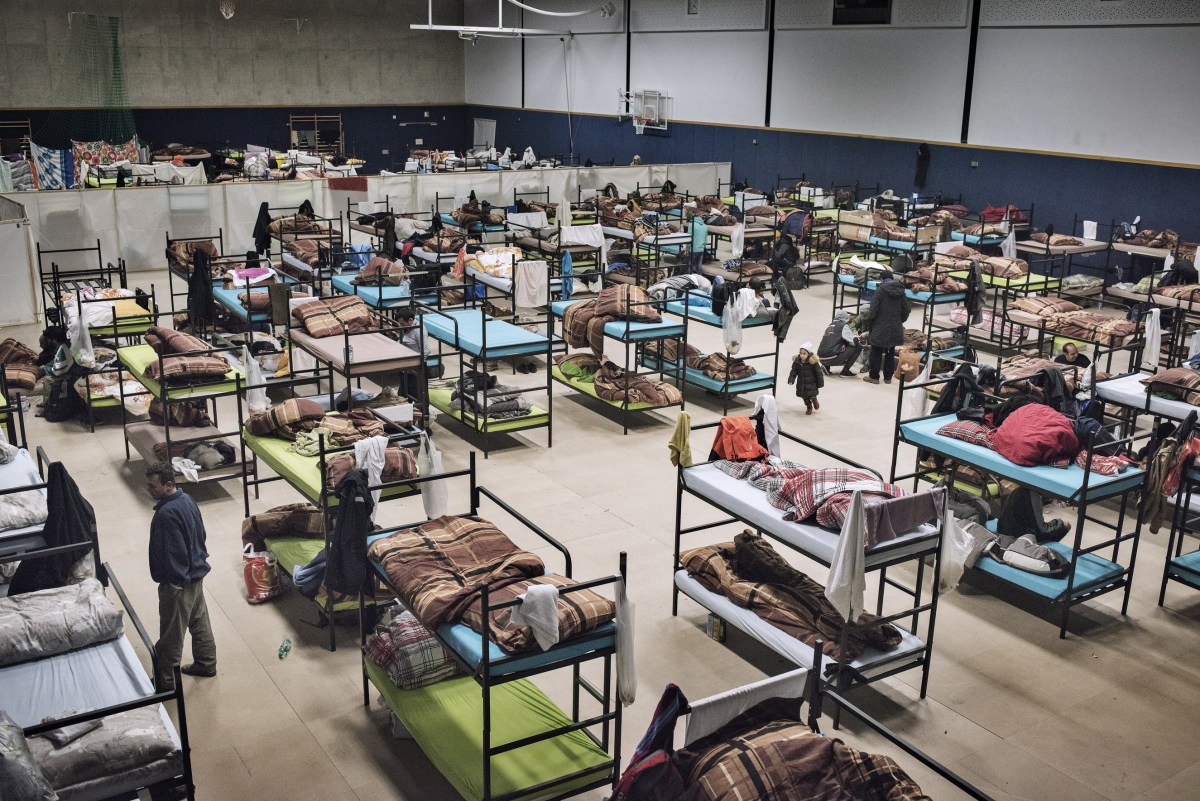
At the same time, Merkel's barefaced confidence—"We tin can handle this!"—is running upwardly against the exhaustion of the volunteers. Social-service centers in Berlin alone were receiving 500 to 600 people a 24-hour interval in belatedly November. They were housed everywhere from school gymnasiums (displacing kids past twenty-four hour period and adult leagues past night) to the old Stasi headquarters (where wiretap listening rooms turned out to serve wonderfully every bit bedrooms). "I think she said 1 sentence too much: 'Everybody is welcome,'" says Silvia Kostner, spokeswoman for the Berlin office of LaGeSo, the federal social-services bureau, just speaking personally. "People took information technology as an invitation. Information technology wasn't an invitation … They have to find a solution to reduce the flow."
Merkel is working on that, negotiating with Turkish President Recep Tayyip Erdogan to shut off the faucet. Armed with €3 billion from the E.U. to help care for refugees on its side of the Aegean, Turkey on Nov. 30 made its showtime significant sweep of smugglers, sending 250 police to raid beaches facing Lesbos. Meanwhile, Germany struggles to hasten asylum decisions, certifying those fleeing war and sending abode those fleeing poverty. Merkel speaks at present of "legal migration." Rules. Germans still like those, and it's become clear why.
But the Chancellor is in an unfamiliar place—out forepart. For years she was defendant of governing so effectively from the heart that her coalition sucked all the oxygen out of High german politics. Today there'due south so much oxygen that some fear combustion. Right-wing parties across Europe have constitute an updraft in what is being chosen Merkel's naiveté, as well as her (and so far largely vain) call for other E.U. members to accept a share of asylum seekers. The conservative Law and Justice Party swept into power in neighboring Poland on October. 25, in an election dominated by the refugee crisis. "You cannot call information technology solidarity when some countries try to, in a style, export problems that they brought on themselves," said incoming Prime Minister Beata Szydlo. In France, polls showed that Marine Le Pen's nativist National Front would win a national election if one were held today. In the initial round of local elections held on Dec. 6, the political party finished first in six of 13 regions.
Germany's right wing has surged as well, with thousands attending weekly anti-immigrant rallies in Dresden, the benighted city where television from the West did not achieve. "What unites us," says Lutz Bachmann, co-founder of the movement, called Pegida, "is the feeling that the politicians are no longer paying attention to the states."
Some analysts share that concern, arguing that by stigmatizing all right-wingers as neo-Nazis, German postwar politics offers no legitimate outlook for those who find no ear in center-correct parties that, lately, are far more center than right. "There are a bully many people who hold right-fly views but experience totally unrepresented in German politics," says Frank Richter, an adviser to the regional regime of Saxony, whose capital is Dresden. "Yard coalitions by their nature create these weather condition. Anybody is trying to cram into a tiny space in the political center, and no one is engaging with the people closer to the edges." Pegida is not a party, simply the right-wing Alternative for Germany is, and its support has grown since this summer. It could enter Parliament in 2017, the side by side national election.
Merkel has given no indication whether she volition seek a fourth term. Her popularity is sharply down—polls showed uneasiness over Muslim immigrants even before the events of the summer, which her ain Finance Minister, Wolfgang Schäuble, termed an "avalanche." The turmoil is most pronounced in the CDU's sister party in Bavaria, where most refugees arrive. The faction's male leader lectured Merkel from the podium on Nov. 20 as she stood with her eyes downcast.
Still, there'south no competitor on the horizon, and Merkel has more than a twelvemonth to restore the equilibrium to which Germans had grown accepted. All she has to do is end the refugee crunch, persuade the rest of the E.U. to have a few hundred k Muslims amid galloping fears of terrorism, end the state of war in Syria and parry any unforeseen setbacks, like a scandal at Volkswagen, flagship of the nation'south largest industrial sector. Along the way she has to convince Germans that what many call the ultimate rash move is, in fact, visionary. Merkel never claimed to have a vision, and in fact quoted Schmidt as saying anyone who did should take his eyes examined. Simply those who study her say it's been visible, if not always audible, in what 1 calls "her mumbled speeches."
"The eye and soul of Europe is tolerance," she said in one, years before the refugee crisis. "It has taken us centuries to empathize this. Nosotros have persecuted and annihilated one another. We have laid our own country to waste material … The worst period of hatred, devastation and devastation happened not fifty-fifty a generation ago. It was washed in the proper noun of my people."
Germany owns the Holocaust as no other nation owns its crimes. Berlin's celebrated center is stippled with memorials to the nation's victims. Information technology makes for a variegated tourist experience in one of Europe'due south virtually vibrant and affordable cities. Here's the Reichstag, the seat of National Socialism, transformed by a glass dome into a Parliament synonymous with transparency. Here'due south a human being changing out of a bear costume—a bear being the symbol of Berlin—outside the memorial to the slaughter of Gypsies. The memorial to the 6 million Jews exterminated by the Nazis takes upwardly an entire urban center block, exceptional both as a commitment and an feel. Moving through the grid is not and so much disorienting as unsettling. You encounter a person, and an instant afterwards the person is gone.
Merkel'southward legacy—her bold, fraught, immensely empathetic human action of leadership—challenges more than the comfort of European life. Information technology also challenges the comfort of assumptions nigh any grouping, including, if it works out, Germans. And it'south a legacy that flows not but from her childhood experience as a girl trapped backside a wall. Information technology as well follows from what she learned as an adult, applying her disciplined, methodical arroyo to what she calls "the things that matter to united states almost." The Chancellor of Germany put anti-Semitism under her microscope, followed prejudice to its roots and establish fear. Not only of Jews but of any "other," including foreigners. Which takes in the whole globe.
"Fright has never been a good adviser, neither in our personal lives nor in our society," Merkel told a middle-aged woman who rose from an audience on Sept. 3 to ask what the Chancellor intended to do to forestall "Islamization," with so many Muslims entering the country. "Cultures and societies that are shaped by fear," Merkel said, "will without doubt not get a grip on the futurity."
The ending has still to exist written. But that's the moral of the story. —With additional reporting by Massimo Calabresi / Washington
Explore The Curt List
Source: https://time.com/time-person-of-the-year-2015-angela-merkel/
Posted by: duncanboyaceing.blogspot.com
0 Response to "Does German Prime Minister Wear Makeup"
Post a Comment