

how to draw hips at different angles
How to draw a head: A complete guide
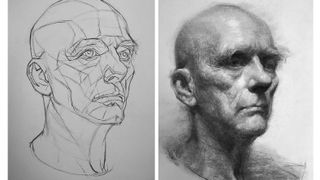
Learning how to draw a head is non a simple endeavor, but it'south a crucial part of whatever artist'south skillset so it's worth putting in the fourth dimension to learn how to practice it well. The head is a very circuitous construction, so in that location are a lot of tips and tricks to chief that'll make it a simpler process. This guide volition break information technology downward for you lot.
On the starting time page, artist Alex Woo will teach you how to describe a head from unlike angles – and how to use shapes to draw the head realistically. The 2nd page, from portrait creative person Oliver Sin, is packed total of tips that will take y'all drawing a head like a pro.
If you lot'd like to conquer other parts of the trunk, see our post of the all-time how to draw tutorials. And if yous need to update your kit, check out the best pencils you lot tin can buy at the moment. Or, keep reading on this page for Woo's pro tips.
How to draw a head: 8 common angles
The head is an incredibly complex structure. I'm not smart enough to procedure all that complexity at the aforementioned time, then I try to break it downwards into a couple elementary shapes, which, for heads, is (i) a sphere for the cranium, and (ii) a pyramid for the nose.
Using these ii basic shapes, you tin can set up the foundation for a drawing of a head at any bending. Yous can learn all this and more from a number of bright lessons over on Schoolism.com.
The angles you'll encounter the most as an artist are:
- Profile
- Straight on
- Upwardly
- Upwardly 3-quarters
- Downward
- 3-quarters
- Down 3-quarters
- Rear three-quarters
You will find yourself returning to these angles over and over again, and so it'due south good to know them well enough that you tin can whip them out with your eyes closed. Any angle that's not covered here tin can be interpolated with some in-betweening.
Commit these eight angles to memory, and start breaking down the head into simple shapes. That'southward the best style to understand a complex object, result, or problem: break it downward into smaller digestible pieces. To depict something is to know it.
01. Profile

When drawing a head from profile, start by arranging your two bones shapes so that they roughly resemble the bending you're looking for. In one case y'all have a good approximation of the relationships between the shapes, you can start building the balance of your drawing from that foundation. As you volition meet from this example and those following, the sphere and pyramid arrangement tin can really help hold your drawings together.
02. Direct on

The straight-on is probably the angle we're most familiar with, as it is the bending at which we see and interact with nigh people in real life. Still, breaking it down into the bones shapes of a sphere and pyramid will help yous maintain the proper proportions and relationships throughout the confront.
03. Up

This is a difficult angle to visualise because nosotros rarely run across people from this vantage betoken. In fact, this was the angle I had the most problem with when I was a immature artist. Nonetheless, breaking the head down into these two simple shapes will make this angle less intimidating. If you find it difficult to rotate the shapes in your head, try gluing a ball and a four-sided die together, and see how the shapes change when you lot turn them.
04. Upwards iii-quarters
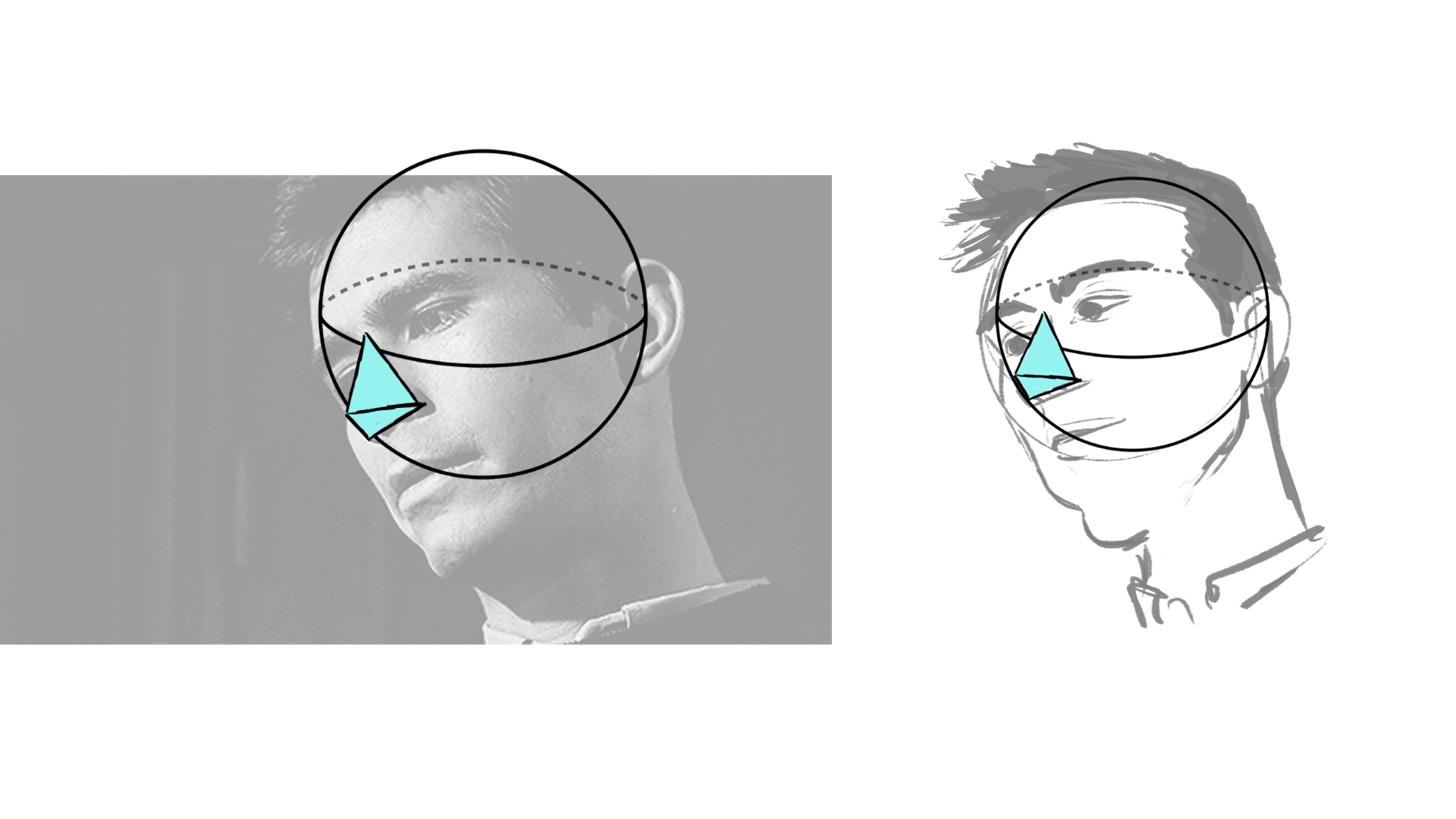
This is a very common angle, as many heroic shots are framed from this vantage signal. You'll find it a lot in comic books, paintings, and print advertisements. Depending on what kind of stories you are telling, this might be an bending worth dedicating your time to in order to master early.
05. Down

This angle is not as common, but it can exist very useful nonetheless in certain storytelling sequences. The key to draw a head from the downwards angle is orienting the head correctly by first establishing the correct position for the nose. This will requite you lot a great "pale in the ground" from which to build the remainder of your drawing.
06. 3-quarters

This is perhaps the nigh popular angle of all in film, portraiture, and illustration. It's often the almost flattering of the angles as information technology shows the most dimension in a person'southward face. This, forth with the up 3-quarters (hero) angle, is worth learning offset.
07. Down iii-quarters

Like the down bending, this vantage is less ofttimes used, but still very handy to know. It's an in-between of the contour and the down angles. Again, existence able to accurately locate the nose from this complicated angle makes all the difference when yous go on to fill in the rest of the face.
08. Rear three-quarters

While the up angle was the hardest for me when I was younger, the rear three-quarters bending is the hardest for me at present. Every time I try it, it never looks quite right. Thankfully, however, when this angle occurs, the person is normally non the focus of the image but is rather more of a compositional element. Nevertheless, information technology's incredibly useful to be able to draw the head from this angle as many "over the shoulder shots" depict the caput from this view.
Next page:15 tips for cartoon realistic heads
Related articles

Source: https://www.creativebloq.com/how-to/how-to-draw-a-head-from-different-angles
Posted by: duncanboyaceing.blogspot.com
0 Response to "how to draw hips at different angles"
Post a Comment